

Certificate in Data Driven Risk Assessment Methods
Elevate your skills in using data-driven methods for risk assessment; gain a certificate emphasizing analytical proficiency and strategic risk management.
Certificate in Data Driven Risk Assessment Methods
Programme Overview
This course is designed for professionals in risk management, data analysts, and IT security officers seeking to enhance their ability to assess risks using data-driven methodologies. Participants will gain skills in data collection, analysis, and interpretation specific to risk assessment, enabling them to make informed and data-backed decisions.
Upon completion, learners will be proficient in using statistical tools and models to identify, quantify, and prioritize risks. They will also understand how to integrate these analyses into strategic risk management plans, ensuring better preparedness and resilience against potential threats.
What You'll Learn
Embark on a transformative journey with our 'Certificate in Data-Driven Risk Assessment Methods,' where you'll unlock the power of data to predict and mitigate risks effectively. This intensive course equips you with advanced analytics tools and methodologies to transform complex data into actionable insights. You'll master quantitative and qualitative risk assessment techniques, learn to interpret big data, and apply machine learning models to enhance decision-making processes.
This certificate will open doors to lucrative careers in cybersecurity, finance, healthcare, and more, where data-driven risk assessment is crucial. Stand out as a sought-after expert capable of navigating the ever-evolving landscape of risk management. Join us to turn data into your greatest ally in assessing and mitigating risks.
Programme Highlights
Industry-Aligned Curriculum
Developed with industry leaders to ensure practical, job-ready skills valued by employers worldwide.
Globally Recognised Certificate
Recognised by employers across 180+ countries as a mark of professional excellence.
Flexible Online Learning
Study at your own pace with lifetime access to all course materials and updates.
Instant Access
Start learning immediately — no application process or waiting period required.
Constantly Updated Content
Stay ahead with the latest industry trends, best practices, and emerging insights.
Career Advancement
87% of graduates report measurable career progression within 6 months of completion.
Topics Covered
- 1. Introduction to Data Driven Risk Assessment: Learners will study the basic principles of data-driven risk assessment and gain foundational knowledge on how to collect, clean, and organize data for risk evaluation. They will learn to use simple statistical tools to identify initial risk indicators.
- 2. Data Analysis Techniques for Risk Assessment: This module covers various data analysis techniques such as descriptive statistics, regression analysis, and basic data visualization methods to help learners understand how to analyze data to assess risks systematically.
- 3. Probability and Statistical Inference in Risk Assessment: Learners will delve into probability theory and statistical inference methods to better understand the uncertainties involved in risk assessment. Practical skills include calculating probabilities and applying hypothesis testing to validate risk hypotheses.
- 4. Machine Learning for Risk Assessment: This module introduces learners to machine learning techniques including classification, regression, and clustering to model and predict risks based on data. They will gain hands-on experience with popular machine learning libraries and tools.
- 5. Risk Modeling and Simulation: Learners will study how to create risk models using simulation techniques such as Monte Carlo simulation to understand potential outcomes and their likelihoods. Practical skills include building and interpreting risk models.
- 6. Advanced Statistical Methods in Risk Assessment: This module covers advanced statistical methods including time series analysis and Bayesian inference to provide a deeper understanding of how to handle complex risk assessment scenarios. Practical applications include forecasting and integrating uncertainty into risk models.
- 7. Ethical Considerations in Data Driven Risk Assessment: Learners will explore the ethical dimensions of data-driven risk assessment, including data privacy, bias in data, and the impact of risk assessment decisions on society. They will learn to apply ethical principles in their risk assessment practices.
- 8. Case Studies in Data Driven Risk Assessment: Through real-world case studies, learners will apply the concepts and skills learned in previous modules to analyze and solve complex risk assessment problems. Practical skills include critical thinking and problem-solving in a data-driven context.
- 9. Risk Communication and Reporting: This module focuses on effective communication of risk assessment findings to stakeholders. Learners will learn to create clear and concise reports and presentations, and understand how to communicate complex data-driven insights in a way that is accessible to non-experts.
- 10. Implementation and Maintenance of Data Driven Risk Assessment Systems: The final module covers the practical aspects of implementing and maintaining data-driven risk assessment systems in real-world settings. Learners will learn about system design, data management, and continuous improvement strategies to ensure the effectiveness of risk assessment practices.
What You Get When You Enroll
Secure checkout • Instant access • Certificate included
Key Facts
For risk managers, analysts, and data scientists
No prior risk assessment experience needed
Understand data-driven risk assessment techniques
Apply statistical methods in risk analysis
Evaluate and mitigate risks using data
Ready to get started?
Join thousands of professionals who already took the next step. Enroll now and get instant access.
Enroll Now — $79Why This Course
Enhance analytical skills with a focus on data-driven approaches to risk assessment, which are crucial in various industries.
Gain practical knowledge in using data to identify, analyze, and mitigate risks, improving decision-making processes.
Develop specialized skills that are in high demand, opening doors to career advancement in fields such as finance, healthcare, and cybersecurity.
Your Path to Certification
Trusted by Professionals Worldwide
Course Brochure
Download our comprehensive course brochure with all details
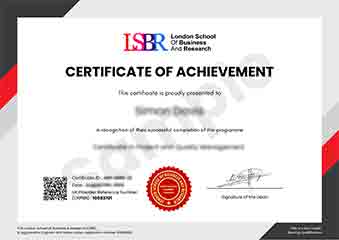
Sample Certificate
Preview the certificate you'll receive upon successful completion of this program.
Get Free Course Info
Enter your details and we'll send you a comprehensive course information pack straight to your inbox.
Employer Sponsored Training
Let your employer invest in your professional development. Request a corporate invoice and get your training funded.
Request Corporate InvoiceWhat People Say About Us
Hear from our students about their experience with the Certificate in Data Driven Risk Assessment Methods at FlexiCourses.
Sophie Brown
United Kingdom"The course provided comprehensive and well-researched material that significantly enhanced my understanding of data-driven risk assessment methods, equipping me with practical skills to analyze and mitigate risks in real-world scenarios. I feel more confident in applying these techniques to improve decision-making processes in my field."
Priya Sharma
India"The certificate in Data-Driven Risk Assessment Methods has been incredibly valuable, equipping me with the skills to analyze complex data sets and make informed decisions, which has opened up new opportunities in my field. This course has not only enhanced my technical abilities but also improved my ability to communicate risk assessments effectively to stakeholders."
Kai Wen Ng
Singapore"The course structure is well-organized, providing a clear pathway from foundational concepts to advanced risk assessment techniques, which has greatly enhanced my understanding and practical application of data-driven methods in various industries. It has been instrumental in my professional growth, offering a wealth of real-world examples that have made the learning experience both engaging and highly beneficial."